White Paper The “Ghost Institution” Risk: Mitigating the Risks of Credential Fraud from Non-Accredited and Physically Non-Existent Entities

1. Executive Summary

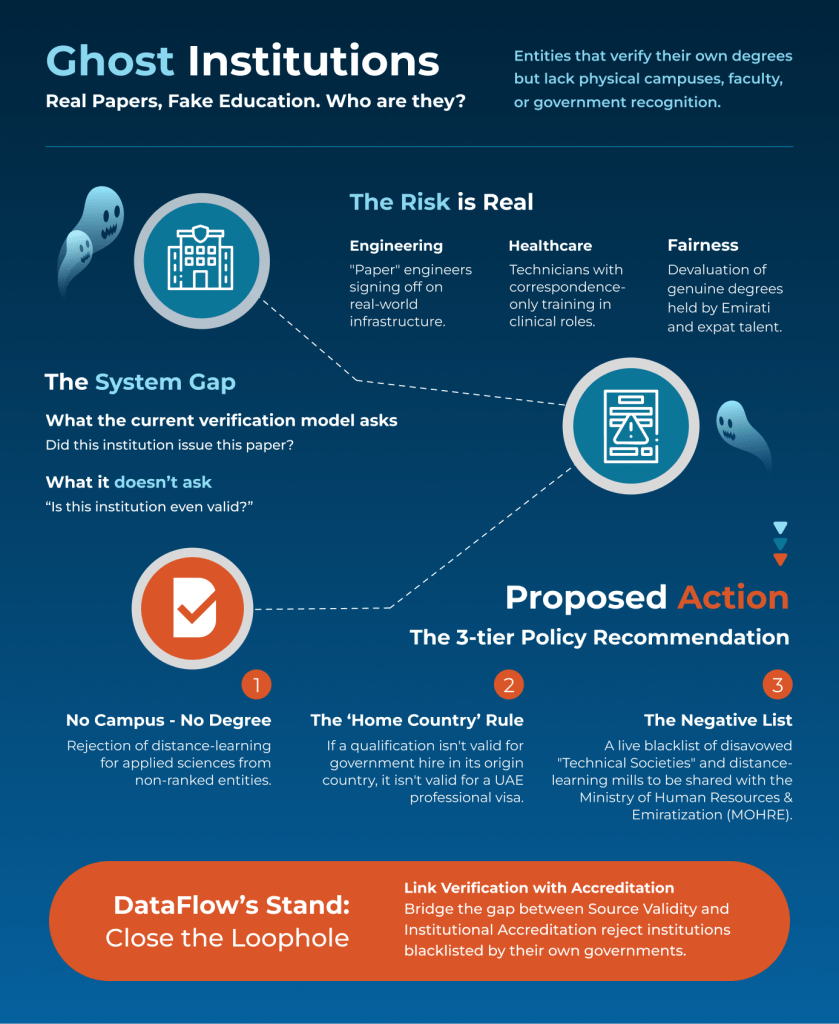
The United Arab Emirates has established itself as a global hub for talent, relying on a robust expatriate workforce to drive Vision 2031. However, the integrity of this workforce is currently threatened by a specific category of credential fraud: The “Ghost Institution.”

Unlike traditional fake degrees (which are outright forgeries), these credentials are “verified” by entities that legally exist on paper but lack physical campuses, academic accreditation, or government recognition in their home countries. A prime example is the continued circulation of certificates from entities such as the Indian Institute of Engineers (IIE) and similar distance-learning “mills” which have been disavowed by their local courts and regulators.

This paper outlines the systemic risks these documents pose to the UAE’s healthcare, engineering, and safety sectors and recommends an immediate policy shift toward Accreditation-Linked Verification.


2. The Problem Definition: “Verified but Worthless”

The current verification model often relies on “Source Validity”—simply asking, “Did this institution issue this paper?”

For Ghost Institutions, the answer is always “Yes,” because the fraud is institutional.

2.1 Characteristics of a Ghost Institution

  • No Physical Infrastructure: The “Institute” often operates solely from a post box or a small administrative office, with no labs, classrooms, or faculty.
  • Legal Limbo: They may be registered as a “Society” or “Trust” (NGO) to bypass University Grants Commission (UGC) or Ministry of Education regulations.
  • Retroactive Invalidity: In many cases, courts in the source country (e.g., the Supreme Court of India) have suspended their right to award degrees, yet the institutions continue to “verify” older certificates to unsuspecting foreign employers.


2.2 Case Study: The “Engineering” Loophole

Entities like the Institution of Civil Engineers (India) or Indian Institute of Engineers historically offered “technician memberships” that were treated as equivalent to B.Tech degrees.

  • The Reality: These exams were often conducted without syllabus oversight or practical lab work.
  • The Status: The Indian Ministry of Human Resource Development (MHRD) and Supreme Court have ruled that widely circulated versions of these qualifications are not valid for employment or higher education if obtained after certain dates (e.g., May 2013).
  • The UAE Risk: If a candidate presents this certificate today, a standard check might confirm “Record Found,” masking the fact that the qualification is legally void in its own country.


3. Strategic Risks to the UAE

3.1 Public Safety & Infrastructure

The UAE is home to some of the world’s most complex engineering projects. Allowing an individual with a “Ghost Degree” to work as a Civil Engineer or Safety Officer creates a catastrophic risk profile.

  • Risk Scenario: A structural engineer whose “degree” involved zero practical lab hours signs off on load-bearing calculations for a high-rise.


3.2 Healthcare Malpractice

While Primary Source Verification (PSV) is strict for doctors, allied health professionals (technicians, radiographers) sometimes slip through using diplomas from unaccredited vocational bodies.

  • Risk Scenario: A lab technician misinterprets critical results because their training was purely theoretical/correspondence-based.


3.3 Erosion of “Emiratization” Standards

As the UAE pushes for high-quality Emiratization, the private sector often benchmarks salaries and roles against expatriate qualifications. If expatriates hold sub-standard “Ghost Degrees” that are recognized as “Bachelor equivalents,” it devalues the genuine degrees held by Emirati graduates, creating unfair competition.

4. The Gap in Current Verification Protocols

Current PSV providers (like DataFlow) are excellent at detecting forged documents. However, they are contractually bound to verify against the issuing authority.

  • The Loophole: If the Issuing Authority is the fraudster, they will validate the fraud.
  • The Missing Link: Verification is currently separated from Accreditation Status.


5. Policy Recommendations for MOHESR

To close this gap, we propose a three-tier policy update:

Recommendation 1: The “Physical Existence” Mandate

MOHESR should mandate that no technical or medical qualification be accepted from an institution that does not possess a physical, inspected campus in its country of origin. Distance learning for applied sciences (Engineering, Medicine, Nursing) should be categorically rejected unless from a top-tier, globally ranked university.


Recommendation 2: The “Home Country” Rule

Policy Rule: “If the qualification is not recognized for employment in the Public Sector of the country of origin, it cannot be recognized in the UAE.”

  • Application: If the Government of India does not hire an IIE graduate as an engineer, the UAE Government must not grant them an Engineering visa.


Recommendation 3: Integrated Accreditation Checks

Shift from “Primary Source Verification” to “Accredited Source Verification.”

The verification process must include a mandatory check against a “Negative List” of institutions.

  • Action: Create a live blacklist of “Non-Accredited / Distance Technical” institutions (e.g., IIE, IME, IETE) to be shared with Ministry of Human Resources & Emiratization (MOHRE).


6. Conclusion

The “Ghost Institution” phenomenon is not about fake candidates; it is about fake education sold to real candidates. By closing the door to these non-accredited entities, MOHESR will not only protect the physical safety of the UAE’s infrastructure but will also elevate the caliber of the expatriate workforce, ensuring it aligns with the world-class standards of the UAE Centennial 2071 plan.


Next Steps

We recommend a joint task force between MOHESR, MOHRE, and PSV Partners to draft the “Negative List” of institutions immediately.

Like the Indian Institution of Engineers (IIE), these entities often have the following characteristics:

  1. Legal Status: Registered as a “Society,” “Trust,” or “NGO,” not a University.
  2. The Loophole: They conduct “Membership Exams” (Section A & B) which they claim are equivalent to a Bachelor’s degree.1
  3. The Reality: They have no physical classrooms or labs, yet they issue “Engineering” degrees which require practical experience.
  4. Verification Trap: They will verify the document because they did issue it. The document is genuine, but the qualification is worthless.


1. The “Indian Professional Bodies” Cluster

(These are the direct equivalents to the IIE, severely impacted by the Indian Supreme Court judgment of 2017 and AICTE non-recognition).

  • The Institution of Civil Engineers (India) – ICE(I):
    • Modus Operandi: Operates similarly to IIE. Issued “AMICE” (Associate Membership) certificates claiming equivalence to B.Tech Civil Engineering.2
    • Status: De-recognized for educational purposes by MHRD/AICTE for newer batches.
  • The Institution of Mechanical Engineers (India) – IME(I):
    • Modus Operandi: Focused on mechanical engineering “technician” memberships sold as degrees. Operates out of a single administrative office.
    • Status: Degrees obtained via distance mode are widely rejected by government bodies and PSUs.
  • The Institution of Electronics and Telecommunication Engineers (IETE):
    • Nuance: Historically a respected body, but its “AMIETE” exams (conducted via distance mode) lost recognition from the MHRD for employment purposes in 2013/2017 rulings, creating a massive “grey area” for graduates after those dates.
  • The Aeronautical Society of India (AeSI):
    • Status: Similar to IETE. While the body is prestigious, the academic equivalence of their Section A & B exams for employment is currently legally contested and often rejected by foreign credential evaluators.


2. The “Deemed University” Distance Violation Cluster

(These are actual universities that physically exist but sold technical degrees outside their legal jurisdiction without labs/attendance).

  • Janardan Rai Nagar Rajasthan Vidyapeeth (JRNRV):
    • The Scam: A “Deemed” university in Rajasthan that opened unapproved “Study Centers” across India. They issued thousands of Engineering degrees to students who never visited the campus.
    • Status: The Indian Supreme Court suspended engineering degrees granted between 2001–2005 and cancelled those after 2005.3
  • Vinayaka Mission’s Research Foundation (VMRF):
    • The Scam: Similar to JRNRV. They offered distance education engineering degrees which were declared invalid because engineering cannot be taught via correspondence.
  • IASE (Institute of Advanced Studies in Education):
    • Status: Heavily involved in the 2017 Supreme Court judgment for issuing unapproved technical degrees via distance mode.


3. The “Axact” Network (The Global Digital Ghosts)

(This is a Pakistani-based network that created hundreds of fake online universities. They are “Ghost Institutions” in the purest sense).

  • Rochville University:
    • Modus Operandi: A website that lets you “convert life experience into a degree.” They have a verification department that answers the phone (staffed by call center agents).
    • Physical Location: None. Just a server.
  • Brooklyn Park University / Nixon University:
    • Status: Sound like legitimate American universities but are completely non-existent. They are dangerous because they offer “verification services” to background check companies.


4. The “Virtual” International Boards

  • Trinity College and University (Spain/UK/USA):
    • Modus Operandi: Not to be confused with the famous Trinity College Dublin or Cambridge. This entity sells degrees based on “prior learning assessment.” It is a classic “Degree Mill” that passes basic checks because it is a registered business.
  • Saint Regis University (Defunct but certificates circulate):
    • Modus Operandi: Based in Liberia (on paper), it sold degrees globally. It had “accreditation” from the Liberian government (obtained via bribery), which made it very hard to detect until the scandal broke.


Why these are dangerous for the UAE 

If a Civil Engineer presents a certificate from The Institution of Civil Engineers (India) dated 2018:

  1. DataFlow/PSV might say: “Verified (Issuing Authority confirmed issuance).”
  2. Reality: The candidate has never stepped foot in a Soil Mechanics lab or a Surveying field test.
  3. Result: The UAE hires a “Paper Engineer” to build real bridges.

Author: Shankho Mitra – Head of Audit, MIS and Analytics, DataFlow Group
UAE’s MOHESR Introduces Simplified Recognition Process for International Qualifications

Are you looking to have your international educational credentials officially recognized in the UAE? If so, there’s a key update you need to be aware of. The responsibility for this process now rests with the UAE’s Ministry of Higher Education & Scientific Research (MOHESR), transitioning from the Ministry of Education (MOE).

At DataFlow, we’re proud to be a trusted partner of MOHESR, helping thousands of applicants like you verify their credentials and take the first step toward recognition. Whether you’re applying for the first time or revisiting the process, we’re here to guide you every step of the way, making the journey as smooth and stress-free as possible.

Here’s everything you need to know to get started:

What is a Recognition Report?

A Recognition Report confirms that your international degree meets the UAE’s academic standards and guidelines. This report is essential for:

  • Employment in the UAE (particularly Education, Licensing & Engineering fields)
  • Higher education opportunities
  • Visa applications
  • Government services


Navigating the Recognition Process: A Step-by-Step Guide

The recognition journey involves two key stages:

Step 1: Degree Verification – Your Starting Point with DataFlow

Before applying for the Qualification Recognition service, your degree must be verified by one of MOHESR’s authorized partners. This is where DataFlow comes in.

What You Need to Do:

  1. Gather Your Documents: The document requirements have now been reduced to make the process easier. Ensure you have the necessary documents ready, including your degree/graduation certificate, transcript, and thesis abstract (if applicable).
  2. Submit for Verification: Simply submit your documents to DataFlow. We will verify your degree and provide you with a verification document.
    • Embassy Verification Validation (If Applicable): If you already have a verification letter from the embassy of the country where you studied, we can validate it for you. (Note: This is not the same as an embassy attestation.)
    • Scholarship Verification for Emirati Nationals: If you are an Emirati national who has completed your scholarship outside the UAE, you can provide a letter from your scholarship authority that verifies the details of your degree.

This initial verification stage is crucial, as it ensures your credentials meet MOHESR’s standards before you proceed to the next stage.

Important Considerations:

  • Translation Requirements: If your documents are not in English or Arabic, you will need to upload legally certified translations.
  • Name Consistency: Ensure that the name on your passport precisely matches the name on all your supporting documents.


Step 2: Applying for Your Qualification Recognition Report with MOHESR

Once you have received your positive verification document from DataFlow, you are ready to apply for your Qualification Recognition Report directly with MOHESR.

What Happens Next?

  • Submit your verification report to MOHESR.
  • Upon successful review and if all recognition criteria are met, your official Qualification Recognition Report will be issued and sent to your registered email address.

This final report officially confirms that your international degree meets the academic standards of the UAE.

Why Choose DataFlow?

Choosing DataFlow as your verification provider offers significant advantages:

  • Trusted by MOHESR: As an authorized partner, we ensure your verification is accurate and reliable.
  • Simplified Process: We guide you every step of the way, making the process as smooth as possible.
  • Faster Results: Our expertise helps speed up the verification process, so you can get your Recognition Report sooner.


Your Second Chance for Recognition

If you’ve previously faced challenges getting your international degree recognized, now’s the time to try again! The updated Recognition service is designed to be more accessible, giving you a renewed chance to leverage your international education for opportunities in the UAE.

Ready to Get Started?

Take advantage of this new and simpler process by MOHESR. Begin your verification with DataFlow today and take the first step toward unlocking the potential of your international degree in the UAE.

👉 Start your verification now: https://dataflowgroup.com/organization/ministry-of-higher-education-and-scientific-research/


DataFlow Voices: Meet Khalil Nouri – Verification Team Lead in Dubai, UAE

Khalil Nouri

This month, we’re excited to feature Khalil Nouri, a Team Leader in our Dubai office. Khalil shares his experience of working with our Verification team, as well as his approach to work, life, and everything in between.

Every month, our DataFlow Voices series highlights the incredible individuals who bring DataFlow’s mission to life. Through these stories, we get a glimpse into their journeys, challenges, and unique perspectives, offering a closer look at the people behind the scenes who make DataFlow what it is.

Hi, my name is Khalil Nouri, and I’m a Team Leader for the Verification team at DataFlow’s Dubai office. I joined the company in November 2020, so it’s been almost four years now. My team primarily focuses on verification services for the UAE and Iran.

I joined DataFlow back in 2020 during the pandemic. Before that, I was working as a Customer Happiness Supervisor and Representative for various governmental and semi-governmental facilities. But, with the pandemic, being a customer happiness representative became challenging. I was looking for a career shift, and a friend introduced me to DataFlow. It was a new and exciting field, and I welcomed the change. I liked the challenge, and I’ve stayed here ever since – hoping to stay much longer!

I didn’t start as a team leader. I initially joined as a Verification Associate for Iran. Over time, I began taking on additional responsibilities, thanks to my previous team leader, who trusted me to manage certain projects. One of the most important projects I led was identifying facilities that were issuing fake employment certificates. This work was significant, as we were able to detect and prevent fraudulent certifications from impacting the industry. This project allowed me to showcase my abilities, which led management to promote me to my current position.

It’s wonderful to work at DataFlow, especially in such a multicultural environment. Every day, you learn something new about different people and cultures. Living in the UAE, a place with over 200 nationalities, teaches you how to understand and respect different backgrounds and beliefs. It’s enlightening to work with a diverse group of people and to understand their likes, dislikes, and unique cultural perspectives.

I live far from the Dubai office, in Ajman, so I spend a lot of time in traffic each morning. To make the most of it, I listen to audiobooks instead of music. It gives me a clearer, more focused start to my day.

As a Persian, one of the most important sayings in our culture is “This too shall pass.” I believe in this deeply. Whether you’re happy or sad, it reminds you that nothing is permanent.

What I value most is the significant impact we have on a global scale. At DataFlow, we provide essential screening services, primarily in healthcare. Our work ensures that qualified, skilled professionals are put in positions where they belong, preventing unqualified individuals from advancing with false credentials. It’s something I take pride in, knowing we help put the right people in the right places.

Funny, honest, and opinionated.

I enjoy spending time with my family—my wife and daughter—and catching up with friends. I like going to coffee shops, playing cards, and relaxing.

With a long commute and a demanding role, achieving balance is essential. I try to give my full focus to work during office hours so that I can leave work behind afterward. DataFlow has a friendly work environment that makes it easy to stay focused without stress. It’s a place where we’re like family, so work doesn’t feel like a burden, and I can transition to personal time without lingering thoughts about work.

I’m 32, but people often think I’m 45! I think it’s because of my grey hair, which I’ve had since a young age—it runs in my family.

Khalil’s journey with DataFlow is one of adaptability, growth, and dedication to his team and the DataFlow mission. His story is a reminder of the values that define DataFlow—a supportive environment where team members can truly thrive. As he continues to contribute his expertise and enthusiasm, we’re grateful to have Khalil and his drive to make an impact every day.

Watch Our Interview With Khalil Nouri

Stay tuned to our DataFlow Voices blog series for more inspiring stories from colleagues like Khalil Nouri. Discover their career journeys, gain insights into life at DataFlow, and learn what drives them to make a meaningful impact on our organization, customers, and mission.

Explore more stories from our team in the DataFlow Voices Series

Honoring Emirati Women in Healthcare: Reflections and Inspirations on Emirati Women’s Day

In honor of Emirati Women’s Day, we had the privilege of speaking with four remarkable Emirati women who are making exceptional strides in the healthcare field.

From navigating challenges and balancing work with family to making impactful contributions, their stories offer a glimpse into the dedication, passion, and resilience that define pioneering women in today’s UAE.

Join us as we explore their journeys, hear about their triumphs, and celebrate the incredible impact they’re making in their communities and beyond.

Dr. Safana Al Fardan

Brain Fellow at the University of Toronto, specializing in Neuropsychiatry.

What kind of influence do you strive to have on your female colleagues and the broader community?

I hope to have an empowering influence on others. I believe that when you empower your team, you strengthen them as a whole and, in turn, strengthen yourself. It takes a team to accomplish things, and people shouldn’t forget that. I also encourage others to step out of their comfort zones and strive to be better because that’s the only way true progression and innovation happens..

Do you have a special message for Emirati Women’s Day?

I would like to thank our wise leadership, especially Sheikha Fatma bint Mubarak Al Ketbi, who has worked hard to ensure gender equality within the female sector. The opportunities provided to us by her and our leadership should not go to waste. We should utilize these resources to reach further heights—after all, the sky is the limit.


Roudha Mohammed Abdulaziz

Radiographer based in Dubai

What do you think is the biggest issue women working in healthcare are facing nowadays?

When talking about the Emirates, we are thankful that we do not face significant problems. Not just in Dubai, but every woman working in the UAE—whether in healthcare or other sectors—feels appreciated and equal. We feel that we are valued just as much as men are.

In the healthcare sector, women feel very safe, equal, and respected. Additionally, there is a remarkable pay scale balance between men and women here. I’ve heard that in countries like the US, there is often a gender pay imbalance, but not in the UAE. Here, women are treated equally and prioritized.

What message would you like to give to Emirati women on this special day?

We should all work together to make a positive impact. There are children and future generations who need us. We need to form a united front, working hand in hand to influence these future generations and contribute to our country.

Do you have any advice for women who want to pursue a career in healthcare in the UAE?

To every woman aspiring to work in the healthcare sector, go for it. Work hard and persevere. I understand that the medical field can be challenging and sometimes frustrating, but dedication and resilience will help you succeed.


Dr. Suhaila AlShaali

Psychiatry specialist and master’s candidate in Psychology and Neuroscience at King’s College, London

How has working in healthcare in the UAE impacted your personal and professional growth?

Working in the UAE has been a unique experience due to its cultural diversity. This exposure has enhanced my ability to understand and assist people from various backgrounds, making the work both professionally challenging and personally enriching. For instance, I once encountered a patient who spoke only Aramaic, which was an unexpected but enriching experience.

How do women in healthcare benefit from working in the UAE?

Women in healthcare in the UAE experience significant benefits. Unlike in some Western countries where gender pay gaps are common, we enjoy more equitable opportunities here. While challenges do exist, there is a growing recognition and ongoing effort to address the issues women face in the workplace.

What are some misconceptions about Emirati women, and how is the current generation addressing them?

One common misconception is that Emirati women are limited in their capabilities. However, today’s generation is proving that the sky is the limit, with Emirati women excelling in various fields, even becoming astronauts. Another misconception is that motherhood diminishes women’s professional abilities, but many women skillfully balance both roles, demonstrating that they can excel in both.

Any message for Emirati Women’s Day?

Happy Emirati Women’s Day! I’m proud to be part of this vibrant community and grateful for the opportunities we have. I encourage every woman to pursue her dreams and reach her full potential.

Dr. Nahla Al Naqbi

Family Medicine Consultant at Saha Clinic

How has working in healthcare in the UAE impacted your personal and professional growth?

Working as an Emirati healthcare professional in the UAE has been highly advantageous. The country offers equal educational opportunities and has supported me through scholarships and leadership roles in various health programs. The presence of many Emirati women in leadership positions is truly inspiring. While balancing work and family life can be challenging, the strong support system in the UAE, including both family and colleagues, helps make it manageable.

What influence do you hope to have on the next generation of Emirati women, especially those aspiring to enter the medical field?

I aim to inspire young Emirati women to approach medicine with both knowledge and compassion. It’s crucial to treat patients holistically, addressing their physical, mental, and emotional well-being. My advice to future physicians is to blend medical expertise with empathy and provide comprehensive support to patients.

Do you have a message for Emirati Women’s Day?

On Emirati Women’s Day, I encourage all Emirati women to value the opportunities available to us in this country. We are fortunate to have supportive leaders and a system that allows us to excel. My message is to remain grateful, continue striving for excellence, and make the most of the opportunities we have.

As we conclude our celebration of Emirati Women’s Day, we’re inspired by the incredible achievements of these trailblazing healthcare professionals. Their experiences and advice underscore the strength and potential of Emirati women in healthcare.

Let’s celebrate their achievements and continue to support and uplift the next generation of female leaders.


DataFlow Voices: Meet Daniel Berago – Verifications Team Lead in Manila, Philippines

We are back with another feature of DataFlow Voices, where we dive into one-on-one interviews with our team members from around the globe.

This month, we spoke to Daniel Berago, Verifications Team Lead at our Manila, Philippines office. Daniel joined DataFlow Group in 2021 and has since experienced exceptional career growth, progressing through the ranks of Applicant Support Associate, Senior Associate, Lead Associate, and now leading his own team.

Keep reading to learn more about Daniel’s journey at DataFlow as he shares his insights on fostering valuable relationships with issuing authorities, streamlining verification workflows, and thriving within a diverse and collaborative work environment.

Hi everyone, I’m Daniel Berago from the Manila office. I joined DataFlow in 2021 as an Applicant Support Associate. Since then, I’ve grown within the verification team, getting promoted to Senior Associate, Lead Associate, and this year, Team Lead.

My interest in verification began while I was a student, handling my own educational background checks. This experience fueled my confidence and made me realize I could excel in this field, particularly with educational components. Building rapport is a strength of mine, which helps smoothen the verification process. I enjoy interacting with people and building relationships, which ultimately honed my verification skills and efficiency.

In the verification role, I’m proud of resolving issues with some issuing authorities. For example, I was able to communicate with my former school’s registrar team and fix problems they faced with verifications. Additionally, connecting with registrars and points of contact at schools has been rewarding. I’ve been able to expedite verifications and build relationships with some institutions. In some cases, I don’t even need to follow up because we have agreements for verification within three to seven business days.

Becoming a Team Lead has increased my involvement in discussions with people from various countries and cultures. I enjoy learning and adapting from these diverse backgrounds, behaviors, and beliefs. It also helps me identify solutions and collaborate with colleagues from other countries to find solutions. I love the culture here at DataFlow.

Being part of the Applicant Support Team was an eye-opener. We interacted directly with applicants and understood their frustrations with waiting for reports. This instilled in me the importance of prioritizing report completion, regardless of the situation. We must find ways to expedite verification and provide applicants with the reports they need to advance their careers globally.

I definitely start my day with a shower, a habit I picked up during the pandemic. Even while working remotely, I usually begin with personal hygiene, a cup of coffee, and planning my day. This involves figuring out which tasks to tackle first and what activities I’ll be working on throughout my shift.

In stressful moments, I remind myself why I started and choose to believe there’s always a solution.

To achieve a good work-life balance, it’s about proper time management, prioritization, and having the right mindset. In my free time, I enjoy playing basketball. However, my age catches up with me sometimes, and I experience aches and pains. But when I have the chance, I still play basketball, spend time with my wife, go out, or simply relax with my family by watching TV. I’m a very spontaneous person.

Loud, friendly, and generous.

Keep an eye out for our next DataFlow Voices blog series, as our team shares what it’s truly like working at the DataFlow Group, and reveals what they cherish most about making a difference in our organization, for our applicants, clients, and our mission.

Learn About Our Global Team Members in the DataFlow Voices Series

Achieving Work-Life Balance: Insights from the DataFlow Team

At DataFlow, we are committed to fostering a thriving work environment that prioritizes the well-being of all our employees. We believe that a healthy and happy workforce lays the foundation for a successful and innovative company.

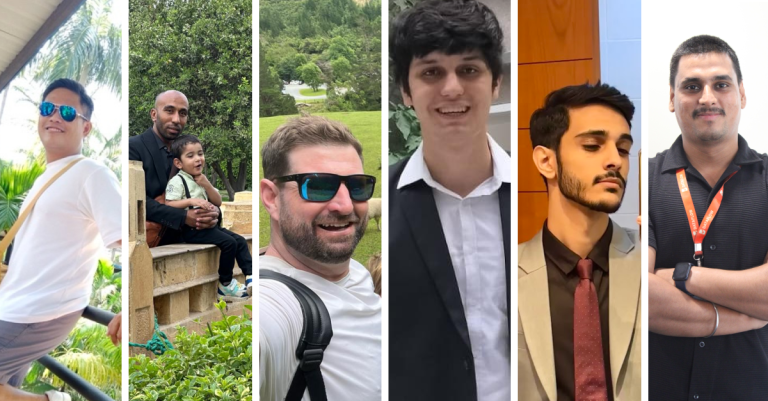
In honor of Men’s Health Awareness Month, we are shining a light on the importance of work-life balance and self-care for our male team members.  So we sat down with some of our team members from around the world to learn about their experiences and how they find balance in their lives.

Here’s what they had to say about the challenges they face in maintaining a healthy work-life balance:


Tony Fargher, Chief Financial Officer – Dubai

“The greatest challenge in my view is that there are so many different challenges we have to deal with at the same time on a daily basis. Difficulty finding/making time to do the exercise we need, combined with access to any food we could dream about at the click of a button, makes it hard to stay fit. Dealing with ever-increasing responsibilities and stress, combined with the stereotypical stigma around men talking about feelings, brings mental health risks. On top of that, everyone has their own personal lifestyle and/or health challenges (including getting older in my case!). And all of this with the natural tendency to just assume everything will turn out alright in the end.”

Top advice: “Spend time talking to people who care about you about your health challenges, both physical and mental. Work together to find solutions and use their support to make incremental improvements for a healthier life. A saying I always remember is, ‘A healthy person has a thousand wishes, a sick person only one.


Mahmoud Ahmad Arab, Verification Associate – Jordan

“Society often expects men to keep their feelings inside, which can lead to depression, anxiety, and even more. It’s important that we make mental health a priority and create spaces where men feel comfortable talking about how they’re feeling.”

Top advice: “It’s okay for men to ask for help when they need it. We should encourage open conversations and create safe spaces where men feel comfortable talking about what’s going on. Taking care of yourself is important too – that means regular check-ups, eating healthy, getting enough sleep, and exercising. Don’t be afraid to reach out to professionals, friends, or support groups if you need extra help. By taking these steps, we can all be healthier and happier.”


Ahmed Rawy, Client Delivery Associate Manager – Egypt

“In my opinion, one of the most significant challenges men’s health faces is chronic stress. From work demands to personal responsibilities, the constant pressure can have a cascading effect, contributing to various health concerns, including cardiovascular issues, hypertension, and even mental health struggles.”

Top advice: “Prioritize well-being by striving for a healthy work-life balance and implementing effective stress management techniques. This could include regular exercise, relaxation methods, or simply learning to delegate and say no. Prioritizing self-care is crucial for overall health and well-being.”


Kartik Kapoor, Talent Acquisition Lead Associate – India

“As a man with a full-time job and family, finding work-life balance is a major challenge. Men often get caught up in work, neglecting loved ones. The constant pressure to provide for the family can come at the cost of physical and mental health.”

Top advice: “Men’s health is critical. Take care of your nutrition by avoiding junk food and sugary drinks. Stay active – play sports, hit the gym, or find another physical activity you enjoy. Staying hydrated is also important. If your body is active, your mind will be energized. Break the monotony of a sedentary work life by making an effort to stay active.”


Pranav Gupta, Human Resources Intern – India

“One of the greatest challenges is living up to societal standards and norms. The lack of work-life balance and pressure to conform can take a toll both physically and mentally. Many men don’t have a platform to express themselves and struggle alone, not realizing the impact it can have.”

Top advice: “A healthy body keeps a healthy mind. Make time for physical activity and prioritize speaking up about your feelings. Remember, you don’t have to go through things alone.”


Daniel Edward Berago, Verification Team Leader – Philippines

“Maintaining consistency with diet and exercise can be challenging with a busy work life.”

Top advice: “Develop a consistent routine for diet and exercise, even with a busy schedule. Remember your “why” and set personal goals for yourself.”

These insights reflect diverse perspectives within our team. At DataFlow, we believe in fostering open conversations about well-being and providing resources to support a healthy work-life balance for all our employees.

Explore more enriching conversations with the DataFlow team here:

DataFlow Voices: Meet Batool Abdelqader – Senior Graphic Designer and Web Developer in Jordan

We are back with another feature of DataFlow Voices, delving into one-on-one interviews with our team members from around the globe. This month, we spoke to Batool Abdelqader, Senior Graphic Designer and Web Developer at the DataFlow Group.

Batool has been with the company for almost ten years and is based in Jordan. She shares her experiences working in a diverse multicultural environment, her daily work routine, and her love for cats and crafts.

Join us to learn more about her journey and what makes her passionate about her work.

Hi, I am Batool. I am a graphic designer and web developer at the DataFlow Group. I have been here since 2014, and am based in Jordan. My job involves creating visual concepts for DataFlow’s print and digital media and working closely with the marketing and commercial teams.

I was attracted to the idea of working for a company that provides opportunities to people who deserve them and creates a safer future for all of us.

It has been an incredible experience and a great opportunity for me. It was my first time in such a diverse setting, and I have learned so much from it. Meeting people from various backgrounds has been truly enriching.

I am proud of everything I have done here. I have learned a lot and started many projects from scratch, such as the website and the employee Intranet.

The first thing I do is feed my cats and check on them. Then I prepare a cup of tea and start my working day by checking my emails and diving into my tasks.

Passionate, positive, and a cat lover.

I like creating art, working on crafting projects, and building new things. I also enjoy watching tutorials about these activities.

I focus on my work during the day and take care of personal tasks afterward. This helps me keep my work and personal life separate.

I love listening to metal and rock music. I like Metallica, System of a Down and symphonic metal like Evanescence and Within Temptation.

Always take chances. Do not fear change, and do what feels right, regardless of the outcome.

Keep an eye out for our next DataFlow Voices blog series, as our team shares what it’s truly like working at the DataFlow Group, and reveals what they cherish most about making a difference in our organization, for our applicants, clients, and our mission.

Learn About Our Global Team Members in the DataFlow Voices Series


DataFlow Voices: Meet CVSS Surya Narayana – Associate Senior Manager in India

Welcome back to DataFlow Voices! In this edition, we’re excited to bring you an exclusive one-on-one interview with CVSS Surya Narayana, a founding team member at DataFlow Hyderabad, India.

Surya takes us on a journey through the remarkable growth of the Hyderabad team, now boasting 84 employees. Join us as we delve into Surya’s remarkable achievements and inspiring journey with DataFlow.

I am CVSS Surya Narayana, a founding team member of the DataFlow Group in Hyderabad. Currently, I serve as the Associate Senior Manager. It’s been a remarkable 17-year journey with DataFlow.

The investigative nature in me drew me towards DataFlow. Initially, I began my career as a field associate with another verification company. In 2007, I joined the DataFlow Group as one of the founding members in Hyderabad, India.

In 2007,  I was one of two DataFlow team members in Hyderabad and we started working from my residence. Today, we have an incredible office that proudly hosts a team of 84 employees. It’s been incredibly gratifying to witness this growth.

Overall, it’s been a positive experience. Interacting with teams from different global offices provides unique cultural insights. Despite the differences, there’s a sense of family within DataFlow, which I find truly rewarding.

My day starts early, around 4:35 AM, as I prepare my kids for school and drop them off by 8:40 AM. I make sure I’m at the office by 9 AM.

My motto for the past 17 years has been, “If it has to be done, it shall be done.” I believe in following through on commitments with unwavering determination.

Over the years, I’ve encountered several instances where my investigative skills have helped uncover fraudulent activities. For instance, we recently discovered fake certificates from a hospital in Andhra Pradesh, underscoring the importance of thorough verification processes. Now, when I examine an Issuing Authority such as a university or any hospital or clinic, I can confidently discern between fake and genuine documents.

Regarding education verification, around 2009, we began scrutinizing the recognition status of institutes offering specific courses. As of 2024, I have submitted approximately 4,500 Right to Information Act (RTI) requests pertaining to the accreditation of institutions offering various engineering, paramedical, and medical programs to obtain information about accreditation statuses and details regarding the accreditation process and criteria.

Ambitious, a smart worker, and passionate.

I cherish spending time with my family, especially cooking for them during weekends.

By allocating ample time and energy between family and work, I strive to strike a balance.

I’d like to emphasize the importance of integrity and a positive attitude in contributing to the organization’s success. My journey with DataFlow has been immensely rewarding and I’m grateful for the opportunities it has provided.


Watch Our Interview With CVSS Surya Narayana

Keep an eye out for our next DataFlow Voices blog series, as our team shares what it’s truly like working at the DataFlow Group, and reveals what they cherish most about making a difference in our organization, for our applicants, clients, and our mission.

Learn About Our Global Team Members in the DataFlow Voices Series

DataFlow Voices: Meet Rahul Bachchas – Information Security Manager

Rahul Bachchas, Information Security Manager

What guiding principle or mantra do you personally follow?

I believe in the power of taking small, consistent steps toward my goals, and the results speak for themselves!

What do you like to do in your spare time?

I aspire to become a Chief Information Security Officer (CISO) and that involves continuous learning. I’m an avid reader and love exploring books on information security. I also follow a lot of YouTube channels that share best industry practices on how to implement security throughout your organization. It helps me stay on top of my game.

What’s something about you that people wouldn’t guess?

Life has its twists! My childhood dream was to become a cricketer, but I eventually found my passion in information security. And I wouldn’t have it any other way.

Watch Our Interview With Rahul Bachchas


Learn About Our Global Team Members in the DataFlow Voices Series

Keep an eye out for our next DataFlow Voices blog series, as our team shares what it’s truly like working at the DataFlow Group, and reveals what they cherish most about making a difference in our organization, for our applicants, clients, and our mission.

How to Get an MoE Equivalency Certificate in the UAE

How To Obtain a Certificate of Recognition

Let’s guide you through the MoE equivalency application process:

Step 1: Gather the Required Documents

Before starting your MoE equivalency application, gather the necessary documents, including educational transcripts, degree or diploma certifications, and a valid passport.

To complete your application, obtain a UAE PASS, the country’s digital identity. Download the app from Google Play or the App Store and register for a free account with a valid Emirates or GCC ID, or passport.

Step 2: Get Your Degree Verified With DataFlow

You must verify your degree before applying for your equivalency certificate. DataFlow will confirm your degree or validate a verification letter from your embassy of the country where you studied, a separate process from embassy attestation. If you have a scholarship (applicable for UAE nationals), DataFlow will validate that as well.

DataFlow will process supplementary documents needed by MoE based on your specialization and degree level, such as an abstract letter, research paper, and proof of residence.

Step 3: Complete Your MoE Application

After receiving your verification report from DataFlow, apply for your Certificate of Recognition on the MoE website. Log in or register for an account with your UAE PASS, ensuring your application details match the information on your supporting documents.

Step 4: Pay the Application Fee

Complete your application by paying the non-refundable fee on the MoE portal – fees vary (100 AED for an undergraduate degree, 150 AED for a postgraduate degree, 200 AED for a doctorate).

Step 5: Obtaining your Certification of Recognition

After review, the MoE will grant equivalency or reject your application. If approved, your certificate will be issued within two days to your registered email address.

Resources and Support Available During the Application Process

Throughout your application, a range of resources and support is available to assist you in obtaining this essential certificate.

For your DataFlow report:

For your Certificate of Registration application, check out:

  • MoE website
  • Customer Happiness Centers
  • Hotline service

Ready to start your MoE equivalency application?

Obtaining a Certificate of Recognition is crucial, especially for professionals seeking employment in high-risk industries like healthcare, engineering, or construction.

Before you start your application, ensure your degree is verified with DataFlow. Our trusted and efficient qualification check and verification services guarantee that your qualifications meet the requirements, increasing your chances of a successful application with the Ministry of Education.